AI Content Detection

Artificial intelligence is transforming education. Tools like ChatGPT, Claude, Gemini, DeepSeek, and Grok help create content faster but also increase the risk of violating academic integrity.

To meet this challenge, StrikePlagiarism.com developed an advanced AI Detection module, integrated into the interactive Similarity Report. It enables simultaneous evaluation of plagiarism and AI-generated content, ensuring transparent and fair analysis.

By selecting AI Content Detection from the left menu, users access a detailed report showing AI probability and the AI Content Indicator — helping institutions protect academic integrity and maintain educational standards.
With StrikePlagiarism.com, institutions gain a reliable partner in upholding academic integrity and educational quality.

How does AI detection work?

The module applied supervised learning using several models, including a modified BERT model, to predict whether content is artificial or original. The artificial intelligence was presented with millions of texts of both AI and original content and then trained to determine the difference between the two. After each training session, a large set of test data is used to evaluate whether the new model is an improvement or not.

Linguistic analysis

Since the content created by AI is generated based on templates, it is not surprising that in it you can notice repeated phrases, strange syntax or the absence of nuances characteristic of human writing.

Statistical analysis

Many platforms use statistical models to assess text complexity, sentence structure, and vocabulary usage to determine whether the text was written by AI. Texts created by AI often have a uniform sentence structure and length, which distinguishes them from human writing.

Machine learning models

Machine learning models (for example, Originality.AI) are trained to distinguish between human and AI texts. They use various features of the text, including the above-mentioned methods, to learn to identify characteristic features that indicate AI writing.

AI Content Report Interpretation

What does AI content probability (probability coefficient) mean?

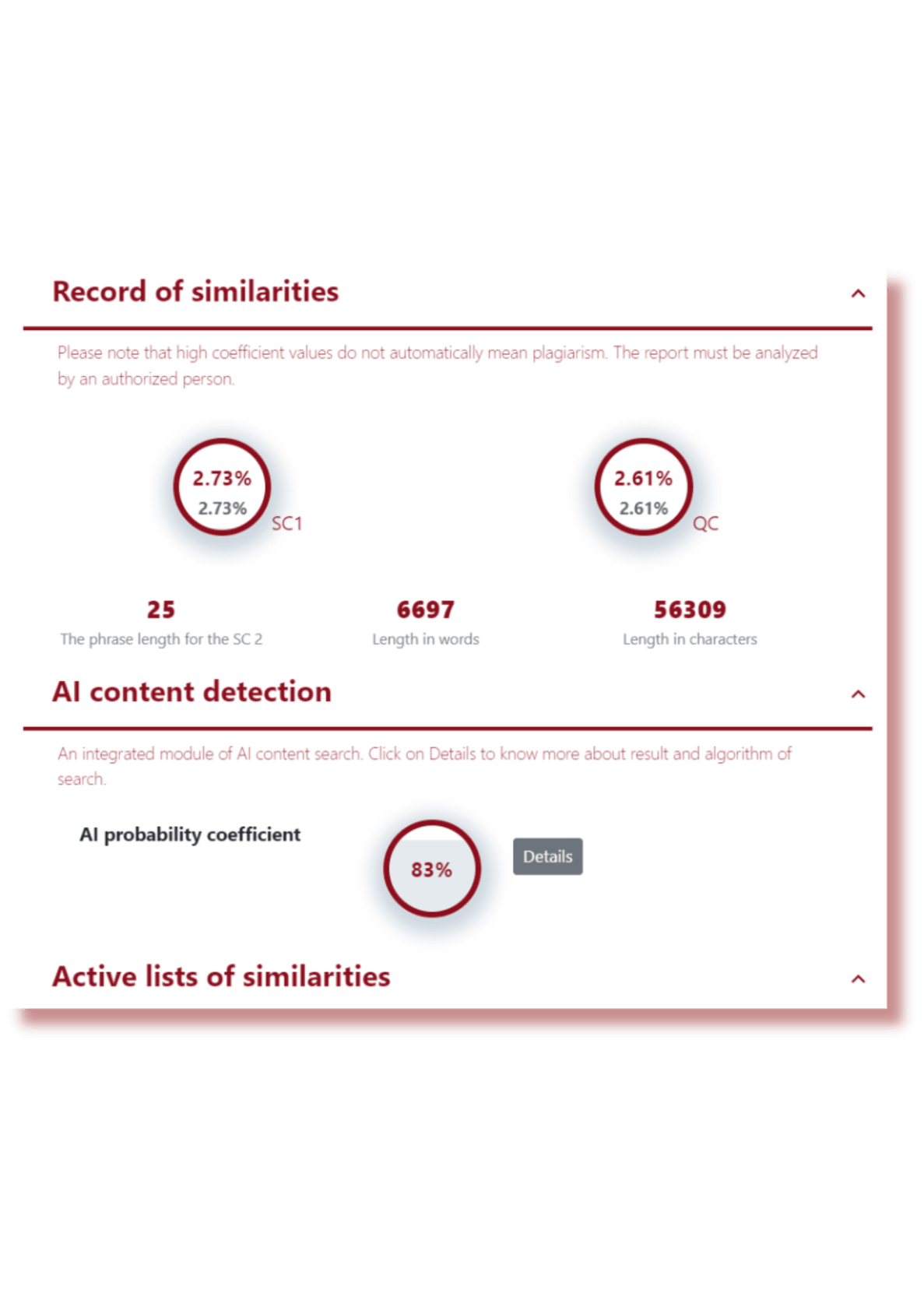
AI Content Probability Coefficient is a prediction of the likelihood of whether the whole entire text was generated by AI or written by a human. The coefficient is not a measure of the ratio of AI-generated text to the original content of the document.
If the author of an paper has a low Similarity Coefficient but a high AI Content Probability Coefficient, this is most likely a false response from the system, so the document should be analyzed in detail.

AI content Indicator

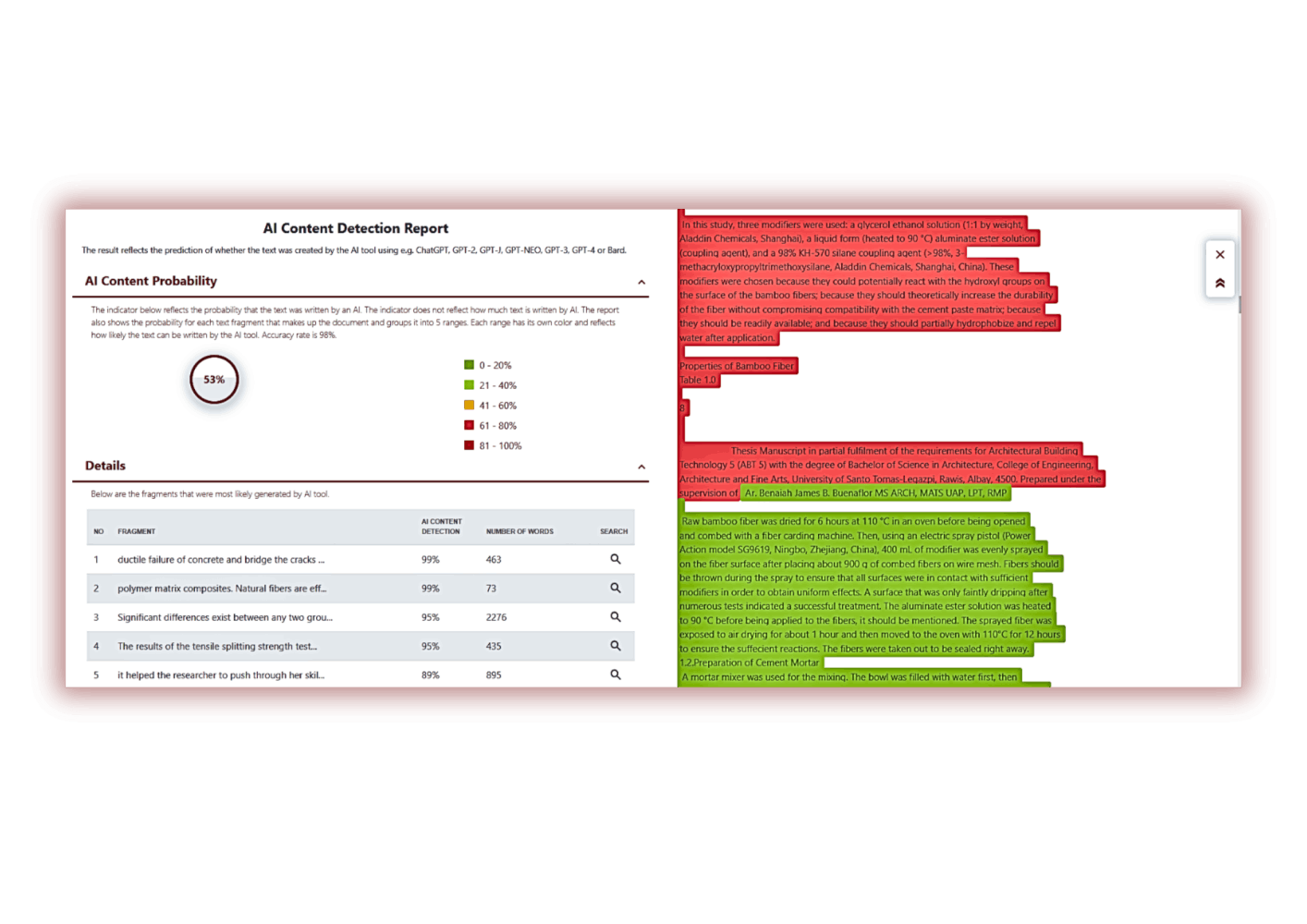
To see in the report only the fragments with high probability of AI we designed an additional tool. The user can now easily display only those fragments which are mostly interesting for analyzing, for example, those where the AI probability coefficient exceeds 60% or even 80%. Meantime, we use a threshold value for AI content indicator. After enabling it the system highlights only the fragments exceeding threshold value.

Color codes in AI Probability Report

Our report traces both the AI probability ratio and the AI probability for each text fragment by colouring the fragments. Each colour represents the probability of whether the text is written by an AI or a human. The report shows a list of fragments and the AI Probability Coefficient for each fragment.


If the text is green, the probability that it is machine written is minimal, if it is red, the probability that it is machine written is maximum.

These colours cannot be changed manually, accepted or rejected. The probability that the text is machine written is checked by the modules and algorithms that are the best at the moment. 

Multilingual AI-content detection


StrikePlagiarism.com detects AI-generated content in over 100 languages, including English, Chinese (Mandarin), Hindi, Spanish, French, Arabic, Portuguese, Indonesian (Bahasa), Urdu, German, Vietnamese, Filipino (Tagalog), Malay, Tamil, Italian, Catalan, Polish, Dutch, Romanian, Greek, Hungarian, Czech, Swedish, Danish, Slovak, Norwegian, Finnish, Lithuanian, Estonian, etc., ensuring unparalleled analytical precision and upholding academic integrity.

Important to Remember

It is important to remember that no AI detection system is absolutely perfect — but precision matters.
The StrikePlagiarism.com AI Detection module achieves over 94% accuracy in identifying text generated by the latest neural networks such as GPT-5, GPT-4o, Claude, Gemini, DeepSeek, and Grok. While minor deviations may occur, the system provides a highly reliable and data-driven foundation for academic evaluation.

For the most objective assessment, it is recommended to analyse a series of documents written by the same author rather than relying on a single submission. This approach enhances interpretive accuracy and reduces the risk of false conclusions.

Document length also plays a crucial role — the longer the text, the higher the detection reliability. The Advanced Probability Analysis tool allows adjusting the AI probability threshold with a slider to display the percentage of text exceeding the selected AI probability level.

With StrikePlagiarism.com, institutions gain a transparent, evidence-based approach to AI content analysis that supports academic integrity and reinforces trust in educational outcomes.